
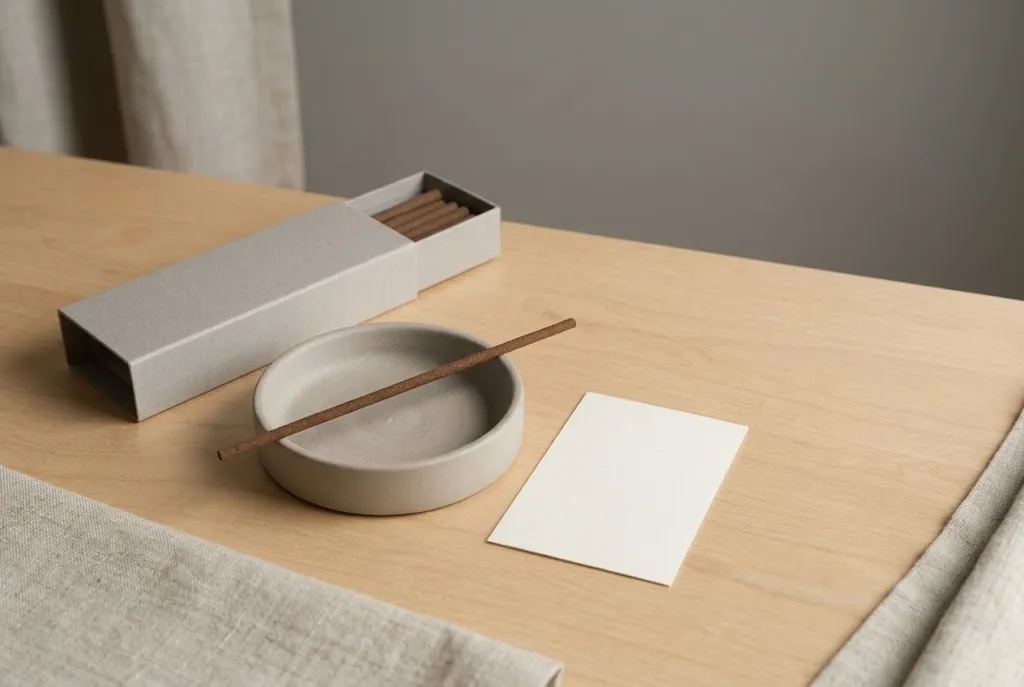
Woody, resinous, sweet, smoky, and earthy are useful words for describing agarwood incense, but they do not mean the same thing to every person. A practical way to understand an agarwood scent is to separate the aroma you notice before lighting from the way it changes while burning. This guide explains common scent words, shows how to compare two agarwood incense products fairly, and helps you choose based on descriptions you can actually verify.
This is not a guide to grading agarwood or identifying its origin. Those topics require different evidence. Here, the focus is simpler: how to read an agarwood scent description, observe a burning session responsibly, and decide whether a particular incense matches your preferences.
Before lighting, notice the incense at a short distance. Some agarwood incense has a quiet woody aroma before burning; others may seem more neutral until heated. The unlit aroma can offer a first impression, but it is not a complete prediction of the burning experience.
Do not hold an incense stick directly beneath your nose or inhale deeply from close range. Instead, place it on a clean surface, wait a moment, and notice whether you detect woody, resinous, sweet, earthy, or smoky notes. If you are comparing products, use the same distance, room, and time of day for each one.
The unlit aroma may also be affected by packaging and storage. A stick stored beside strongly scented items can pick up external smells. If an unexpected perfume, food, or musty note appears, check the storage environment before assuming it reflects the incense itself.
Scent descriptions are useful because they give you a shared vocabulary, but they are not standardized measurements. Two products described as “woody” may feel quite different in practice.
| Scent word | What it often suggests | What it does not prove |
|---|---|---|
| Woody | A dry, forest-like or timber-like direction | The product contains a particular percentage of agarwood |
| Resinous | A deeper, warmer, more substantial aromatic character | The product is pure, natural, or high grade |
| Sweet | Honey-like, soft, or gently rounded notes | The product contains added sweeteners or fragrance oils |
| Smoky | A note associated with burning | The incense will necessarily smell harsh or unpleasant |
| Earthy | A grounded, soil-like or mature character | The product is old, wild-harvested, or more authentic |
| Clean | A restrained, less heavy impression | The product is smoke-free or safe for everyone |
Treat these words as clues, not guarantees. A useful product description explains the intended aroma direction; it does not need to promise a specific emotional result or health benefit.
Agarwood incense may not smell identical from the first moments of burning to the end. Some products begin with a more immediate woody note, then develop warmer, sweeter, or more resinous characteristics. Others remain relatively consistent.
Observe one stick at a time. Light it according to the product instructions, place it in a suitable holder, and allow the aroma to settle before making a judgment. Avoid lighting several products at once, especially when you are trying to understand the differences between them.
A fair comparison needs similar conditions:
Do not lean close to the smoke or inhale directly. If the aroma feels uncomfortable, extinguish or remove the incense according to the product instructions and ventilate the space.
An agarwood scent and the smell of burning material are related but not identical. A woody or resinous aroma can become clearer as the incense burns, while a harsh, acrid, or excessively smoky impression may come from the burning process, airflow, holder placement, or product-specific factors.
If an incense smells more like burning wood than the aroma you expected, first separate a normal woody note from a harsh or acrid burn. DFXY’s troubleshooting guide addresses this distinction in more detail. [web:425]
A disappointing burning session does not automatically mean the agarwood scent is poor. It may mean the room was too enclosed, the holder was unsuitable, another scent was competing in the space, or the product was not used according to its instructions. Check one variable at a time rather than drawing a conclusion from a single session.
When comparing two agarwood incense products, use the same criteria for both. Start with the written descriptions, then compare your own observations under similar conditions.
| Comparison point | Product A | Product B | What to record |
|---|---|---|---|
| Stated aroma | Use the seller’s exact wording | Use the seller’s exact wording | Woody, resinous, sweet, smoky, or other stated notes |
| Unlit impression | Your observation | Your observation | Aroma noticed before lighting |
| Early burning impression | Your observation | Your observation | The first characteristics you notice |
| Later development | Your observation | Your observation | Whether the aroma becomes warmer, sweeter, or more resinous |
| Overall preference | Your conclusion | Your conclusion | Which profile you would choose again |
Do not compare a product burned in a small enclosed room with one burned in a ventilated space. Do not compare a fresh stick with one that has been stored beside perfume or food. Consistent conditions matter more than a single dramatic impression.
If you enjoy dry, forest-like aromas, look for descriptions that emphasize woody or resinous characteristics. If you prefer a softer impression, descriptions mentioning honey-like sweetness, warm woods, or a restrained profile may be more relevant. If you dislike heavy scents, look for products described as restrained rather than assuming that every agarwood incense will smell the same.
DFXY publicly describes one Hainan Chong Lou agarwood incense as developing smooth woody notes, a soft resin character, aged wood, and restrained honey-like sweetness as it burns. That is an example of a specific product description; it should not be treated as a universal description of all agarwood incense. [web:268]
Your preference is the most useful filter. A well-described product helps you find it, but no scent word can guarantee that a particular incense will suit your room, mood, or sensitivity.
Start with one product and one suitable holder. Read the product instructions, use the incense in a ventilated space, and keep the burning stick away from children, pets, curtains, paper, and other flammable items. Never leave burning incense unattended.
Keep a simple note of what you noticed: the aroma before lighting, the first impression after lighting, and whether the character changed over time. Over several sessions, these notes are more useful than trying to remember every detail from memory.
If you want to explore agarwood incense further, browse DFXY’s agarwood incense sticks collection and compare the specific aroma descriptions before choosing. A clear description and a suitable setup will tell you more than a generic claim.

Agarwood incense is often described with words such as woody, resinous, warm, earthy, smoky, or gently sweet. The exact experience depends on the specific product, burning conditions, and personal sensitivity.
No. “Woody” describes an aroma direction. It does not prove the presence, percentage, origin, or quality of agarwood.
The unlit aroma and the burning aroma are different experiences. Heat can reveal or change certain characteristics, and room airflow, holder placement, and product instructions also affect the session.
It is better to compare one product per session. Burning several products together can make it difficult to tell which aroma characteristics belong to which stick.
No. “Smoky” describes a possible aromatic character associated with burning. It does not automatically mean harsh, acrid, or unpleasant.
Use one stick in a suitable holder, follow the product instructions, and observe the aroma under consistent conditions. Stop using it if the smoke or scent feels uncomfortable.