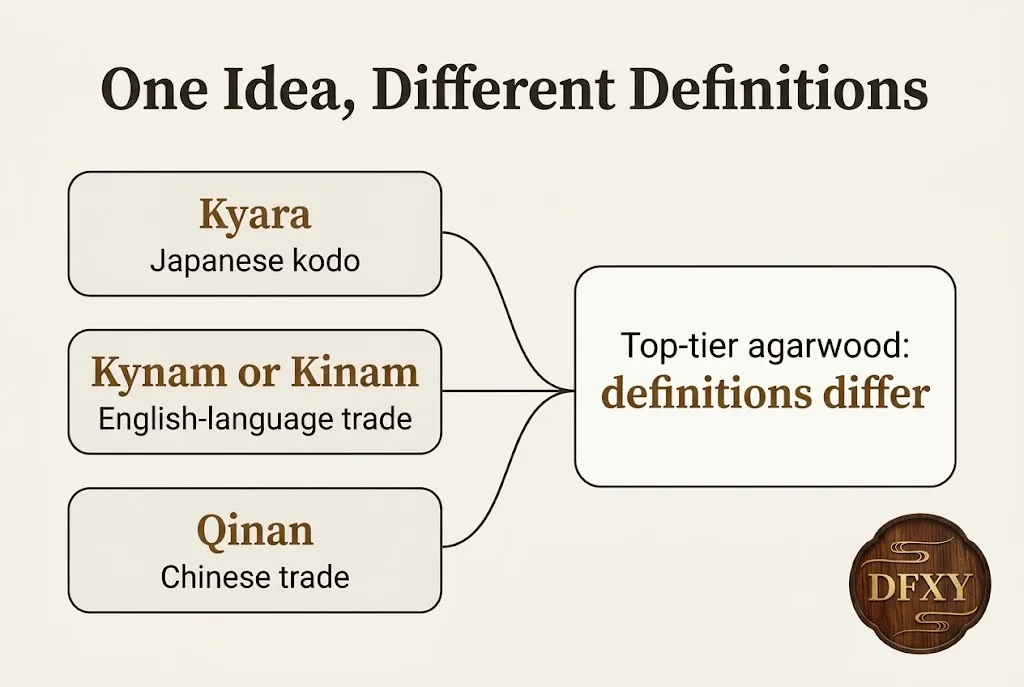
Kyara, kynam and qinan are names for the most prized tier of agarwood, used in Japanese, Chinese and English-language trade. Sources agree on that much, then disagree on whether the name is a grade or a type, whether the wood can be cultivated and what it should cost. Before you buy anything sold under one of these names, ask what it means for that exact product.
Sources last checked: 25 October 2026.
In this guide
Most sellers use the three names for one idea. A peer-reviewed study on grafted kynam describes kynam as a rare, high-quality agarwood, also known as kyara and qinan among other names, with a high resin content, a soft texture and a distinctive aroma.
That agreement stops at the edges. A perfumery’s reposted forum excerpt says the Japanese reserve kyara for a narrow range of origins and call similar wood from elsewhere kyara-like, and that the definition has widened in artisan circles and some Chinese circles as supply shrank. When two sellers use the same word, they may not mean the same thing.
Kyara belongs to Japanese incense practice, known as kodo, where agarwood is the subject of appreciation. It is the first of six categories in the rikkoku-gomi framework. A Kamakura incense house lists them as kyara, rakoku, manaban, manaka, sasora and sumotara, uses them to classify aromatic woods by quality, and describes kyara as gentle and elegant, with a spicy taste and Vietnam among its places of origin.
The framework was assembled around the fifteenth century, when agarwood reached Japan from only a few sources. A kodo specialist writing about it says it is not an exhaustive system for all agarwood and not sufficient for complete grading, and suggests enjoying it as a snapshot of high-quality agarwood from centuries ago. The same writer warns that a piece with an attractive resin pattern can still be ordinary grade and should not be priced as a top one. So the word kyara on an incense box signals a tradition. It does not tell you the origin, age or resin content of the wood inside.
Sellers frame it differently. One fragrance retailer calls kinam a grade, not a species, separated from ordinary agarwood by how much resin the wood holds and how long it took to form. A kodo specialist describes kyara and kynam as a special type or grade of aloeswood with distinctive fragrance properties, says how it forms is unknown, and notes that the species cannot be identified from non-living wood alone.
That specialist also warns that the word is easily abused for quick profit, because few people have handled authentic material. The practical lesson is simple: treat the name as a claim to be explained, not as proof.
| Name | What it often signals | What it does not prove |
|---|---|---|
| Kyara (Japanese kodo) | The first category in the rikkoku-gomi framework; the top tier of agarwood | Origin, age, resin content, or that a finished stick contains only that wood |
| Kynam or kinam (English spellings) | The same top tier, widely used in English-language trade | A fixed definition, or whether the wood is wild or cultivated |
| Qinan (Chinese trade) | The Chinese-market name for the same idea, where one source says usage has widened | The species, authenticity or quality of the specific product |
Sources disagree, and the dates matter. A 2013 article by the kodo specialist above said no cultivated kyara was known at that time. The peer-reviewed study, published in 2023, describes grafted kynam agarwood from cultivated Aquilaria sinensis as meeting the definition of premium kynam, and reports a higher resin extract content than in normal agarwood. The authors also note that DNA barcoding of 58 market batches only tentatively identified the source species.
Retailers take opposite positions as well. One seller’s glossary entry says kyara is harvested from extremely old, wild-grown trees, while another seller’s guide says it is produced by controlled fungal inoculation of cultivated trees. Neither statement tells you what a particular box contains. Ask the seller which one applies to the item you are considering.
Published figures cannot settle the question. One retailer lists sinking-grade kyara at roughly 30 to 100 dollars per gram. Another seller says authenticated material can exceed 10,000 dollars per gram. The fragrance retailer cited above reports trade prices from about 500 dollars to above 10,000 dollars per gram, and points out that the figures come from traders who benefit from large numbers.
These are prices for raw wood, not for finished incense sticks. A price tells you little unless you know what the name refers to and what you would actually receive.
Raw agarwood and finished incense are different products. A pack that says qinan may refer to the raw material, an aroma style, a traditional category or a product line, and a finished stick may contain other ingredients besides aromatic wood. Ask which meaning applies and where the full composition is stated.
The DFXY incense label guide separates product identity, materials, construction, fragrance and pack details so each claim stays attached to the right question. Use it as a checklist for any listing, including ours. Aroma words such as sweet, cool or resinous help you describe a preference, but they are impressions rather than proof of a name or a grade.

Use these questions with any seller of kyara, kynam or qinan products, and ask for the answers in writing.
Retailers should avoid repeating a name they cannot support. Ask the supplier to state what it refers to for each item, request permission to use the wording and photographs, and describe the product on your own listing only with information you can document. Gift buyers can use the same questions, because the person receiving the gift will see only the name on the box.
For cross-border orders, the peer-reviewed study notes that both Aquilaria and Gyrinops species are listed in Appendix II of CITES, the convention on international trade in endangered species. Requirements for finished products and for your destination can differ, so confirm the rules for your shipment with the seller and the relevant authority.
The DFXY Qinan Handmade Incense page currently describes a refined woody aroma and a handmade format. It does not state a kyara grade or the origin of the wood. If those details affect your decision, ask us for the information available for that item before ordering, and keep the reply with your purchase record. You can also browse the Qinan incense collection for the current range.
Tell us which product you are considering, where it will be delivered and the questions that matter to you, so we can review your request.
Ask About Qinan IncenseMost sellers use them for the same top tier of agarwood, but definitions differ between traditions and sellers. Ask what the name means for the specific product.
Sources describe it both ways. One retailer calls it a grade, while a kodo specialist calls it a special type or grade whose formation is unknown. The name alone does not settle it.
Sources disagree. A 2013 specialist article knew of no cultivated kyara, while a 2023 peer-reviewed study describes grafted kynam from cultivated trees as meeting the definition of premium kynam.
Published figures range from tens of dollars to over 10,000 dollars per gram for raw wood. Prices for finished incense depend on what the product actually contains.
Aquilaria and Gyrinops species are listed in CITES Appendix II, so commercial shipments may need documentation. Confirm the rules for your destination with the seller and the relevant authority.
Ask the supplier to state what the name refers to for each item, and describe the product on your own listing only with wording you can document.