
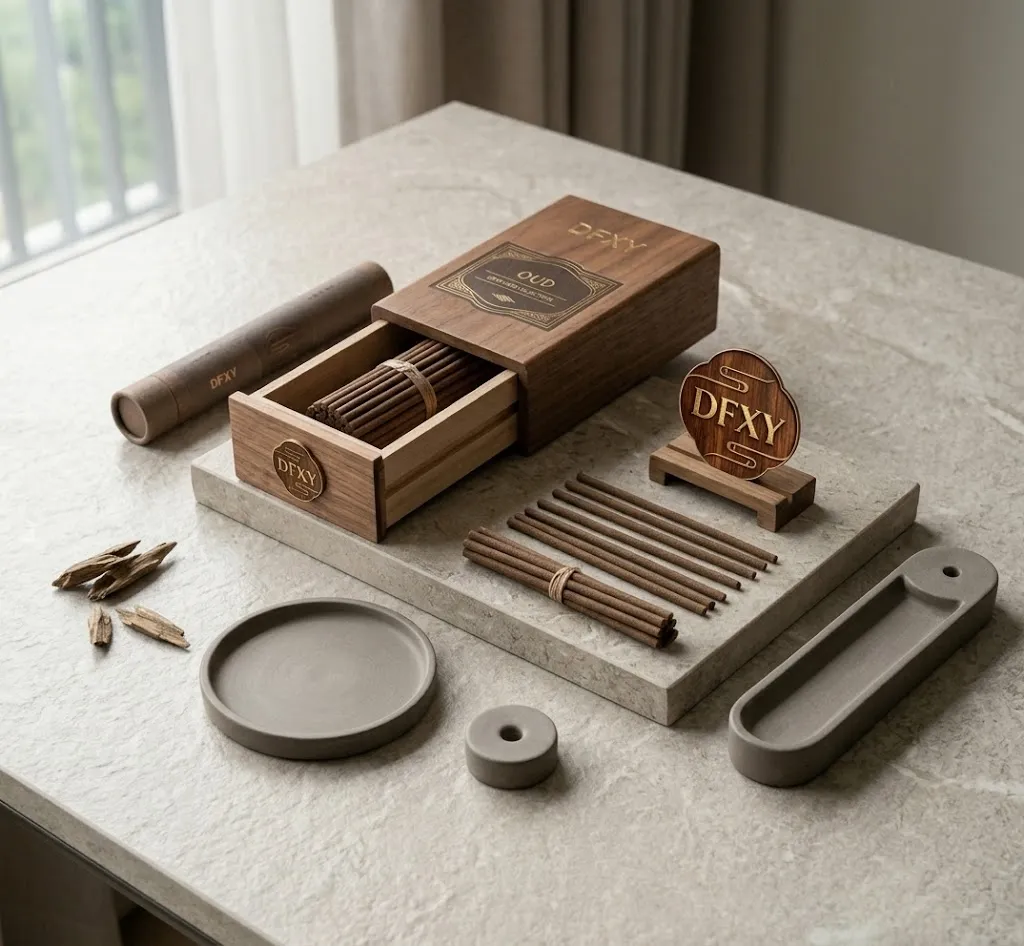
When choosing incense holders for sticks, start with the incense you actually use, not the photograph of a beautifully styled desk. A holder must support the product’s construction, remain stable and collect falling ash. For coreless agarwood incense, the whole stick is incense material; there is no bare bamboo end to insert into a support designed only for that purpose.
The previous sample-comparison guide helps you decide which fragrance you enjoy. This guide answers the next practical question: will your chosen stick fit the holder and the space where you intend to use it? It is a compatibility guide, not a ranking of incense grades or a promise that an attractive accessory makes burning risk-free.
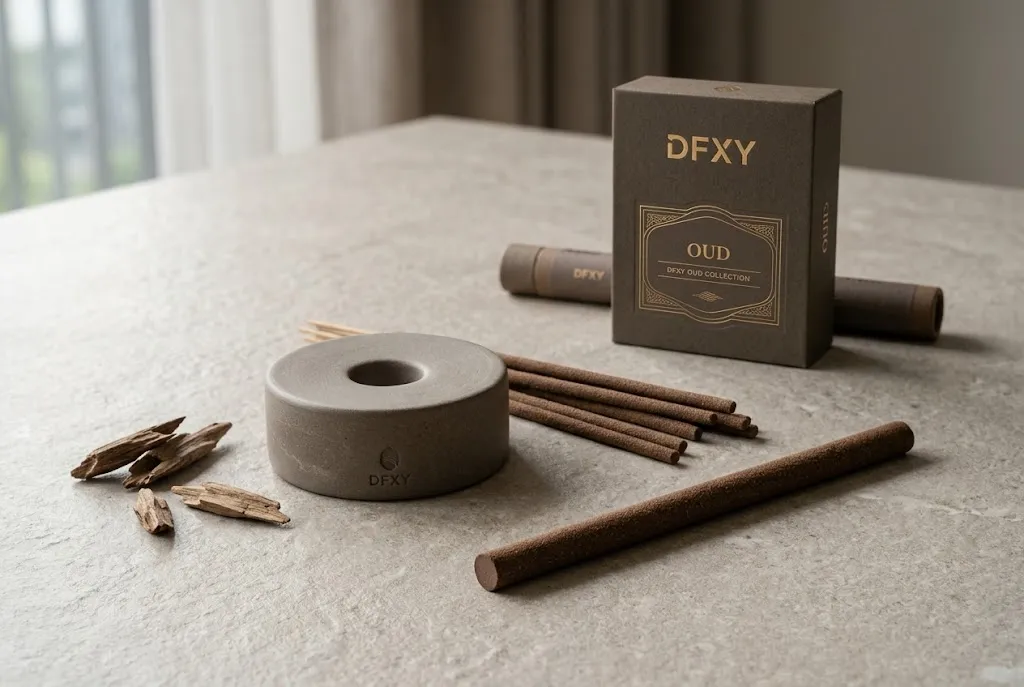
Check whether your incense is coreless, bamboo-cored, a cone or another format. A holder described simply as suitable for incense may not support all of them. Do not rely on the word universal without checking which construction and dimensions the maker includes in that claim.
A hole intended for a narrow exposed bamboo end may be unsuitable for a solid coreless stick. Ask whether the holder supports the incense body itself. If you are considering chips or bakhoor instead, use the format-comparison guide first: those products are not made compatible with a stick holder by changing the angle or adding a decorative tray.
Record the stick’s length and diameter from its listing or supplier-confirmed information. A stated length of 21 cm is useful for planning the ash-catching area, but it does not reveal the hole size you need. Different finished sticks can vary in thickness, so do not assume that one opening fits every product in a range.
Request the opening size, intended stick diameter and any supported length range. There is no single clearance figure that this article can responsibly apply to every design. A socket, clamp and suspended support work differently. Check the manufacturer’s guidance rather than forcing a stick into an opening because it looks close enough.
Use an unlit stick to check the fit before any burning. If it does not insert as intended, stop. Do not force, shave, wet or alter a sample to make an incompatible holder appear suitable. A stick that cracks during insertion is not ready to use, and a loose stick should not be accepted simply because it remains upright for a moment.
Treat an unlit fit check as an initial observation, not a safety certification. Confirm that the intended support does not lean, wobble or require constant adjustment. The holder’s published instructions still govern use; passing a quick desk check cannot establish its behaviour with heat or replace product-specific guidance.
The support and the ash-catching area may be separate pieces. A small ceramic insert can hold a stick without collecting everything that falls from it. Check whether a non-combustible tray is required and whether that tray is included. Styled photographs often show accessories that must be confirmed in the actual package contents.
For an angled design, consider the horizontal area below the stick, not just the width of the base. With the stick unlit, inspect whether the space beneath it lies over the intended catcher. Do not change the specified angle merely to make the product fit a smaller tray. Air movement can affect where ash lands, so this check does not guarantee perfect containment.
An upright holder can have a small visual footprint, but stability and clearance still matter. A long tray may offer a larger collection area while occupying more space. A bowl or enclosed design has its own loading, ventilation and cleaning instructions. Choose between these designs by documented compatibility, not by assuming one shape is best for every stick.
Consider how you will remove residue and inspect the support after use. Decorative channels, narrow openings and inaccessible compartments may require a particular cleaning method. Read the instructions before choosing the design. Do not use water, abrasive tools or cleaning chemicals unless the maker permits them for the material and finish.
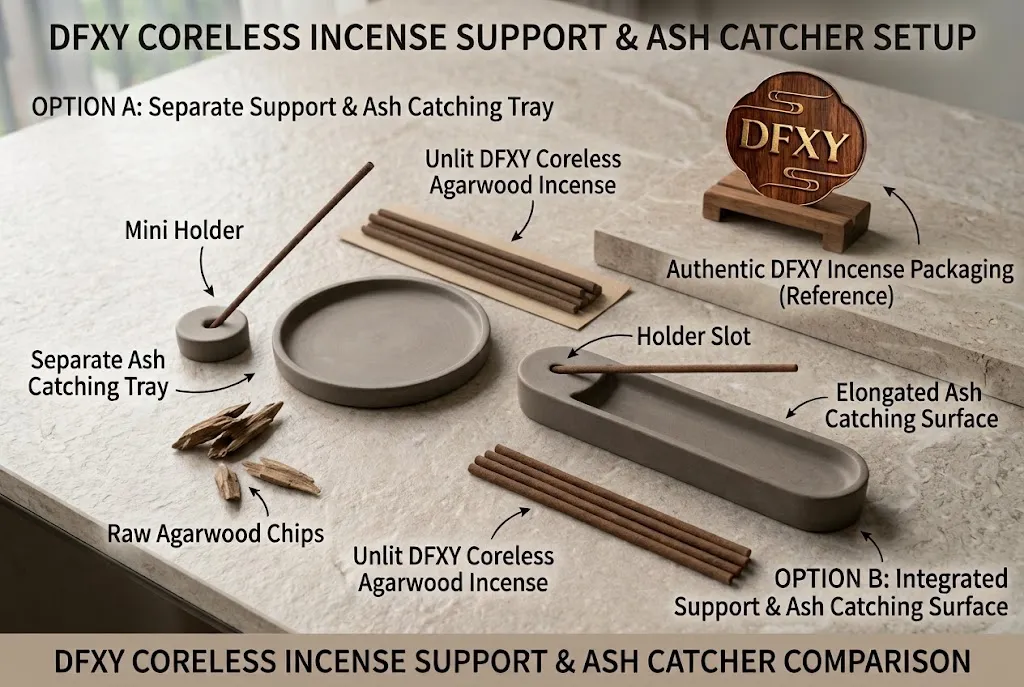
Ceramic and metal are common accessory materials, but the material name alone does not prove that every finish, liner, adhesive or contact surface is suitable for heat. Look for an item intended for the actual incense format. A decorative dish is not automatically an incense holder, and a heat-resistant holder does not make the furniture beneath it protected.
Follow the maker’s instructions for the supporting surface and clearance. Do not treat a closed cover as evidence that smoke has disappeared, or a large tray as permission to leave incense unattended. For the broader operating precautions, read the safe-burning guide; this article stays focused on choosing and matching the equipment.
For a first-time buyer, a straightforward, clearly specified design is easier to assess than an accessory with unclear loading instructions. Confirm what is included before purchasing: the support, tray and any additional fittings may not be sold together. For a gift, verify that the supplied incense and holder are compatible rather than pairing them only by appearance.
For a tea space, compare the holder’s footprint with the working area needed for cups, water and service. Keep the proposed setup separate from tasting equipment and normal movement. The right holder can support a suitable setup, but it cannot prevent fragrance from interfering with tea. An incense-free tasting remains an appropriate option.
For hotels or other shared environments, first establish whether burning incense is allowed in that location. Consider housekeeping access, occupant preferences and accidental contact, not just visual style. A display selected for a photograph may be unsuitable for a service route or guest-accessible surface. Approval of the accessory is separate from permission to use incense.
If you are assembling a retail bundle, test compatibility for the specific products you plan to supply. Do not describe a set as complete unless its contents genuinely include everything you advertise. Ask whether the holder specifications and fitting method remain the same across the ordered items; one sample cannot establish consistency for an entire shipment.
For a DFXY enquiry, identify the exact incense item and the holder you intend to pair with it. Ask for confirmed stick dimensions and available product information. If you need bundled accessories or custom packaging, request confirmation of availability and terms; this guide does not establish that those services are offered for every order.
Before ordering a holder, distinguish confirmed facts from missing details. You should know the incense construction, stick dimensions, support method, collection area, package contents and cleaning requirements. If a listing leaves one of these unclear, ask a focused question. The guide to reading agarwood incense labels can help identify the product details that belong in that enquiry.
A useful request is specific enough for the seller to answer without guessing. Keep the product references and any response with your purchase record. That information is more useful when reordering than a generic claim that the accessory works with all incense.
I use this coreless incense product. Can you confirm the supported stick diameter, holder setup and whether an ash-catching tray is included?
No. A holder intended only for an exposed bamboo end may not support the body of a coreless stick. Confirm the intended format and dimensions with the maker.
Length does not determine opening size. Check the stick diameter and the holder’s loading instructions. Do not use an invented universal clearance.
Not necessarily. The support may require a separate non-combustible tray. Confirm the intended setup and whether that tray is included.
No. Stop if it does not fit as intended. Do not alter the incense or holder to improvise compatibility without the manufacturer’s guidance.
A cover is not evidence that smoke or emissions have disappeared. Follow the design’s instructions and appropriate operating precautions.
No. Check the package contents. Styled images may show components or accessories sold separately.
Confirm compatibility for the actual incense and holder, the included components, use instructions and relevant supply terms. A matching visual style is not enough.