
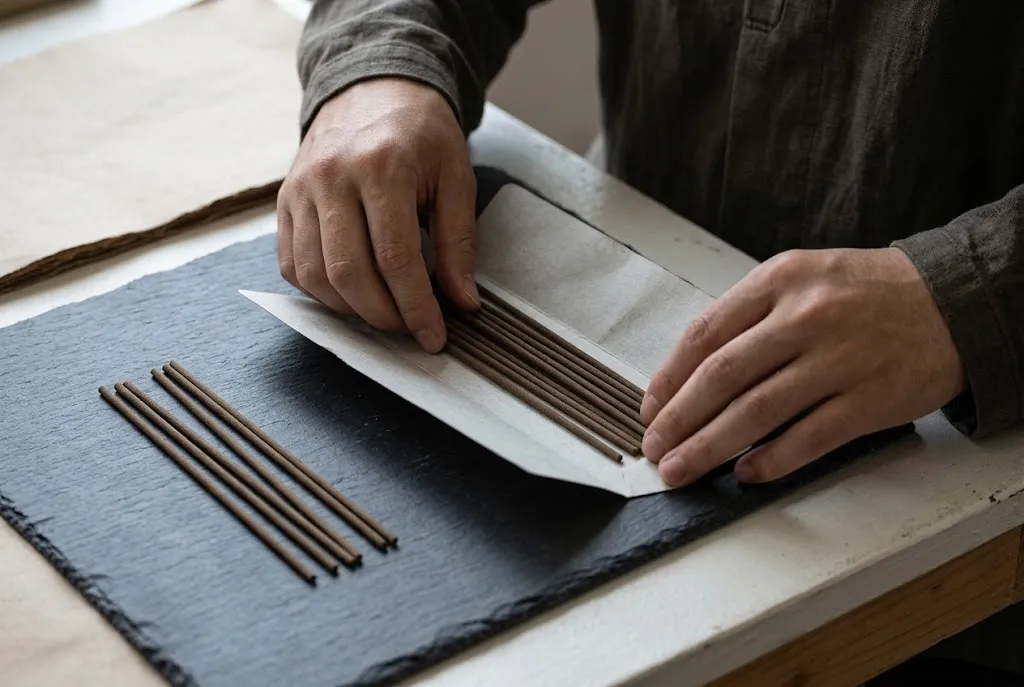
A finished incense stick looks simple. It is slender, dry, and ready to place in a suitable holder. Before it reaches that point, aromatic materials have to become a workable mixture, take a consistent shape, dry, and survive handling and packaging. The craft lies in those transitions, not merely in the appearance of the finished box.
For buyers interested in handcrafted incense, understanding this sequence makes the term more useful. It helps distinguish an explanation of production from a romantic description of tradition. It also explains why equipment and skilled handwork can appear in the same workshop without contradicting each other.
This guide describes a general coreless stick-making workflow, using publicly documented incense production as a reference. It is not a report from a DFXY factory, and it does not establish the ingredients or methods used for any particular DFXY product.
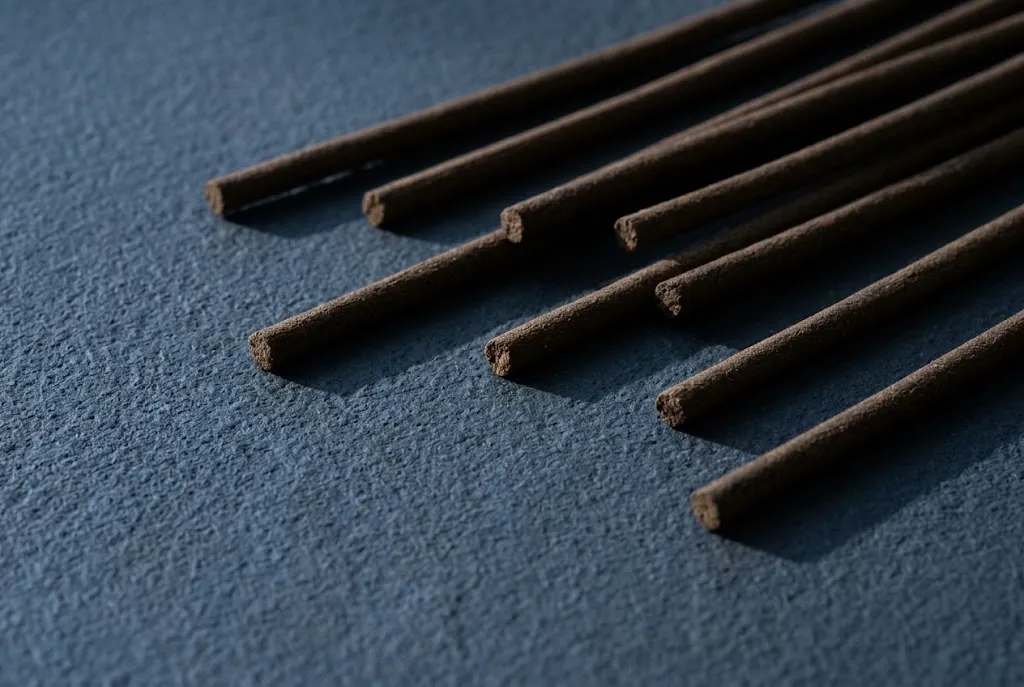
Production begins with a decision about what the incense is meant to be. A single-material aroma direction and a blended fragrance require different formulation choices. An agarwood product should identify its aromatic material clearly enough for the customer to understand what is being offered, rather than relying on the word handmade to explain everything.
The maker then measures the materials for that formula. Shoyeido’s published production sequence starts with accurately measuring powdered aromatic woods, herbs, and spices, followed by sifting and mixing. Its example shows why preparation belongs in the craft story: a finished stick is the result of measured inputs, not simply a handful of attractive raw materials.
Do not assume every agarwood incense follows that specific ingredient list. A useful workshop explanation describes the product’s own formula at an appropriate level, including the role of any binder, instead of borrowing another maker’s recipe or presenting a generic manufacturing photograph as evidence.
The customer does not need a proprietary formula to ask practical questions. Which materials provide the aroma? What holds the stick together? Does the description apply to this exact product? These questions establish a starting point before the conversation moves to shaping or finishing.
Loose powder must become material that can hold a shape. In documented Japanese-style incense production, prepared ingredients are combined into a kneaded mixture before pressing and extrusion. Shoyeido describes adding warm water during kneading, while other explanations of coreless stick production identify a binder as part of the mixture.
This is the point where a process description becomes more informative than a label. Saying that a stick contains powdered fragrant wood does not tell the buyer how it was formed. Conversely, mentioning a binder does not, by itself, prove that a product is poor quality. The relevant question is what the ingredient does in that specific formulation and how clearly the seller describes it.
This article does not prescribe a binder percentage, a water ratio, or a home recipe. Published examples vary, and transferring one maker’s quantities to another material would create false precision. A manufacturing overview should explain the sequence without pretending that every workshop works from the same instructions.
Coreless describes the structure of the incense: there is no separate bamboo or wooden support running through the aromatic body. It does not describe whether every production stage is manual, nor does it establish the product’s ingredient purity, safety, or aromatic quality.
The distinction matters because hand-rolled and coreless are not interchangeable terms. Coreless sticks can be formed with equipment, including extrusion. In Shoyeido’s documented process, a hydraulic machine pushes prepared material through small openings to make long strands, which are received on a board and trimmed by hand.
Here, machinery performs one shaping task while hands still handle and adjust the material. A supplier may reasonably describe meaningful manual work, but the description should identify those stages. Ask whether the handwork involves mixing, forming, cutting, arranging, inspection, or packing rather than assuming that handcrafted means no equipment was involved.
For a buyer, this is a better way to discuss craft. It replaces an all-or-nothing distinction between handmade and machine-made with a specific account of how the product takes shape. The method can then be considered alongside the actual material and finished specification.
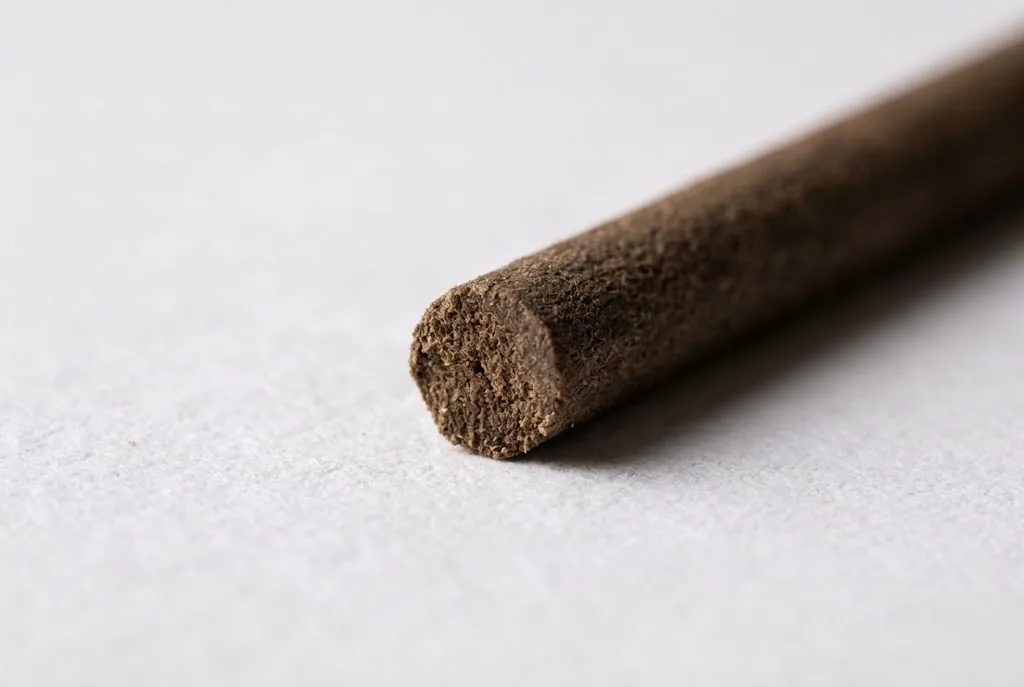
Shaping is not the end of the process. In Shoyeido’s sequence, soft strands are transferred to another board, arranged, adjusted, and moved to drying boards. The finished sticks are then weighed and bundled for packaging.
These handling stages are easy to omit from marketing copy because they are less dramatic than a close-up of fragrant wood or an extrusion tool. Yet they show that a stick passes through several conditions before it becomes a finished product. The workshop is managing a material, not simply producing an attractive silhouette.
Drying also deserves a precise explanation. A supplier should distinguish a general statement that incense is dried from a product-specific claim about drying time or conditions. The duration reported by one manufacturer cannot establish how long another product takes, and a photograph cannot verify that a drying schedule was followed.
A reader should be especially cautious with universal numbers. A claim that all premium agarwood incense must dry for a particular number of days needs evidence for that rule. This guide therefore gives no DFXY drying duration, temperature, humidity target, or production timetable.
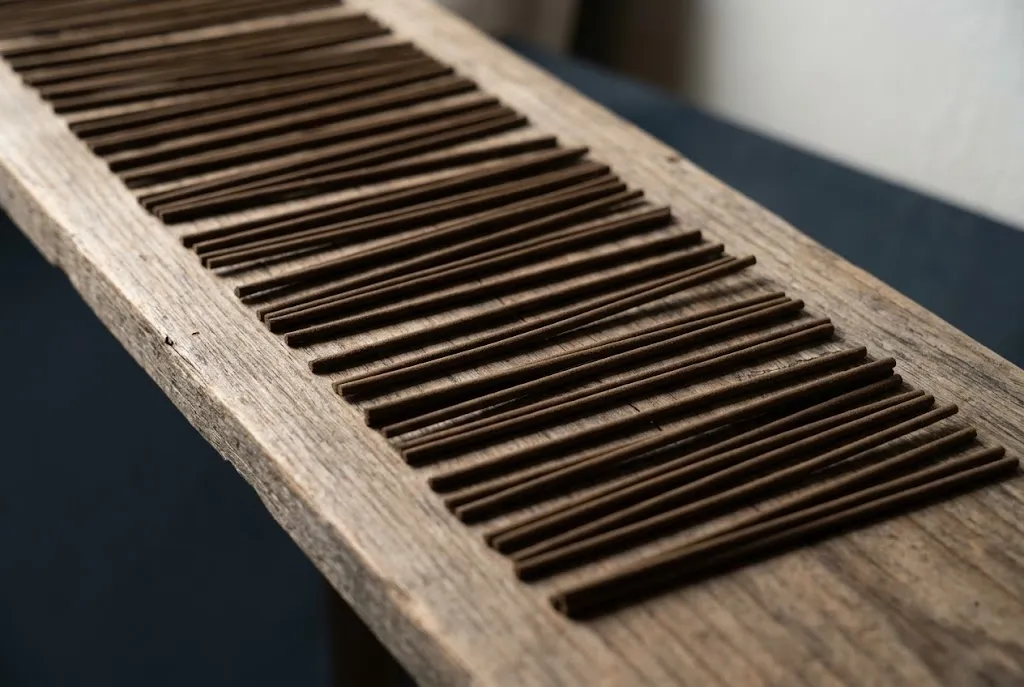
Before purchasing, ask what the maker or seller checks after production. Useful subjects include the finished dimensions, intact sticks, packaging protection, and whether the supplied instructions match the incense format. These are questions to ask, not a claim that every workshop follows an identical inspection system.
A production story is more convincing when it connects those checks to the delivered product. For example, a seller can explain that sticks are packed in a support tray to reduce movement during transport, provided that this is true of the actual SKU. There is no need to invent a laboratory test or imply that visual inspection proves chemical composition.
The same restraint applies to workshop photographs. A picture of someone handling incense may illustrate a stage of work, but it does not establish the identity of the aromatic material, the formula, or the origin of the wood. Product-specific records and clear descriptions must carry those claims.
Handcrafted incense is most useful as a description of work, not as a shortcut to every other quality judgment. Once the process is explained, the buyer can decide how much that work matters to the purchase.
A simple example illustrates the difference. One listing says only “traditional artisan incense.” Another explains that prepared materials are extruded into coreless strands, cut and arranged by hand, dried, and packed to a stated specification. The second description gives the buyer more information about production. It still does not prove superior aroma or establish a safety advantage.
When comparing products, keep three questions separate: what is in the incense, how is it made, and what will you receive? A detailed answer to one does not automatically answer the other two. A workshop story should support the product description, not replace it.
For a first purchase, look for a clearly described format and quantity, relevant use instructions, and a seller who can clarify the production terms. Avoid paying for a story whose practical meaning remains unclear. Craft becomes valuable when it helps you understand the object in front of you.
Not necessarily. Ask which stages involve manual work. A documented process may combine mechanical extrusion with hand cutting, arranging, or packing. The term is more informative when the seller explains those stages.
Yes. Coreless refers to the absence of a separate bamboo or wooden support, not to the shaping method. Extrusion is one documented way to form coreless sticks.
The production label alone does not establish quality. Consider the materials, product description, finished specification, and the maker’s explanation of the work involved.
Not by itself. A binder can have a structural role in stick incense. Ask which binder is used and what the product’s composition claims actually mean, rather than judging from the word alone.
No. It explains a general workflow using published industry references. DFXY-specific production methods, ingredients, and workshop claims require separate confirmation.