
Tell us what you are looking for—daily incense, gifting, guest hospitality, or retail sourcing—and we will help you choose a suitable format.
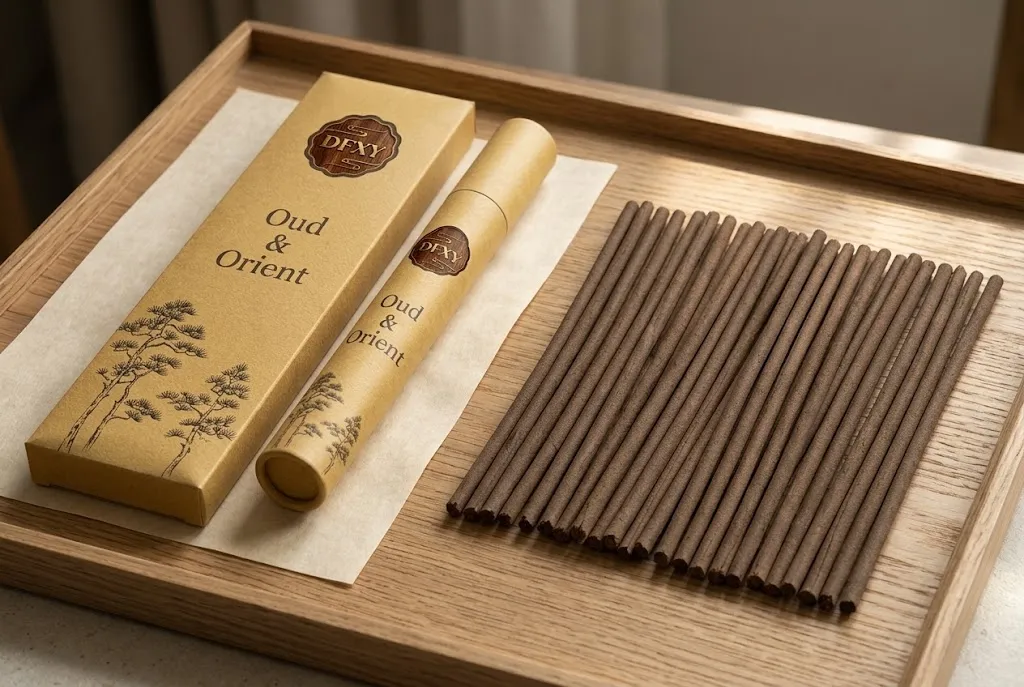
The basic difference is structural.
A coreless incense stick has a continuous incense body with no bamboo support inside it. The shaped incense material forms the entire stick. DFXY describes selected agarwood products as bamboo-free and coreless, meaning there is no separate bamboo or wooden support running through the aromatic body.
A bamboo-cored incense stick is built around a thin bamboo support. The aromatic mixture forms a coating around that central stick, and a portion of bamboo may be left exposed at the base so the incense can be held or placed in a suitable burner.
Neither description tells you everything about the finished product. A coreless stick is not automatically made only from agarwood, and a bamboo-cored stick is not automatically synthetic, inferior, or unsuitable. Material disclosure, aroma description, dimensions, manufacturing choices, and seller transparency still matter.
If a listing uses broad terms such as “pure,” “natural,” or “premium,” read past the headline. Look for what the product actually states about its format, aroma direction, quantity, and use guidance. For a closer look at product descriptions, see How to Read Agarwood Incense Labels.
The table below is designed to help you compare product formats without turning one construction into a universal quality ranking.
| What to compare | Coreless incense | Bamboo-cored incense | What to check before buying |
|---|---|---|---|
| Construction | No bamboo support through the center | Incense coating around a bamboo support | Whether the listing clearly shows and names the stick format |
| Ingredient disclosure | Not determined by the absence of a core | Not determined by the presence of a core | Product-specific material information and any confirmed formulation details |
| Aroma expectations | Read the finished product’s aroma notes | Read the finished product’s aroma notes | Do not predict the complete scent only from the core type |
| Smoke and burn time | Depend on the individual product and use conditions | Depend on the individual product and use conditions | Product guidance, dimensions, airflow, and holder setup |
| Holder fit | Check stick diameter and support method | Check the exposed base and holder opening | A stable fit plus enough space to catch ash |
| Handling | Follow the product’s handling instructions | Follow the product’s handling instructions | Do not force any stick into a holder that is too narrow |
A good comparison begins with what is verifiable. Product photographs can show the structure and scale. Dimensions can tell you whether the stick fits your holder. The aroma description can point you toward a woody, resinous, sweet, dry, or soft direction. None of these details alone tells you how a stick will feel in your own room, but together they give you a sounder basis for choosing.
It can influence the experience, but it does not create a simple rule such as “coreless always smells purer” or “bamboo-cored always smells stronger.” A bamboo support is part of what burns in a bamboo-cored stick, while coreless incense has no separate bamboo support inside the aromatic body. DFXY notes that a bamboo core can contribute its own woody note during burning, but the finished aroma still depends on the complete product—not the core type alone.
The most useful way to compare aroma is to read the product’s own scent description and test a small quantity when possible. A stick described as lightly sweet and woody may suit one buyer better than a darker, more resinous or smoky direction, regardless of whether either stick is coreless or bamboo-cored.
Do not treat a darker stick, thicker stick, lighter ash, or lower price as proof of aroma quality or material authenticity. These are visual or commercial details, not complete evidence. If material transparency is your main concern, use How to Identify Genuine Agarwood Incense: 5 Practical Checks alongside the product page.
Before you choose a format, check the holder you already own. A holder should support the incense securely and catch ash without placing the burning end near unstable or heat-sensitive materials. Stick diameter, length, and the way the holder grips or supports the incense are practical details that matter more than a label alone.
Coreless incense may require a holder designed to support the incense body rather than a bare bamboo end. Bamboo-cored incense may fit a holder differently if it has an exposed bamboo base. Do not force either type into an opening that is too narrow, and do not assume that one holder works safely for every diameter or format.
Choose by the product’s aroma direction, your room size, ventilation, and how you expect to use the incense. A small room does not automatically require coreless incense, and a larger room does not automatically require a bamboo-cored stick. Start with a product that provides clear aroma notes and use guidance, then try one stick in your own setting.
All burning incense produces combustion by-products. Keep the area ventilated, use a heat-resistant holder, and do not leave burning incense unattended. For full operating guidance, see How to Burn Agarwood Incense Safely.
If you are new to agarwood incense, begin with a smaller box or one clearly described product. Use one stick at a time. Notice whether the scent direction suits your space and whether the stick works well with your holder. This is more useful than assuming one format will always match your preferences.
Whether you choose coreless or bamboo-cored incense, use the product page as a buying checklist.
This checklist does not make a purchase decision for you. It gives you the information needed to compare like with like. A clear product page is more useful than a dramatic claim that leaves the essential details unanswered.
For a broader format and room-based selection method, see How to Choose Agarwood Incense for Your Home.
When you compare DFXY agarwood incense sticks, begin with the product’s aroma notes, stick dimensions, format, and use information. Coreless construction can be an important preference, but it is only one part of a complete product decision.
Explore the DFXY collection to compare available sticks by product information and aroma direction before choosing your first box. Before publishing, link this sentence to the verified DFXY agarwood-incense-sticks collection or category page.
No. Coreless describes the absence of a bamboo support in the center of the stick. It does not, by itself, disclose every ingredient or formulation detail. Read the product page for the material description.
No. Do not treat “coreless” as a zero-smoke claim. Burning incense produces combustion by-products, and the experience can vary by product, airflow, and use conditions. Follow the product’s instructions and keep the space ventilated.
No. The two formats have different structures, but neither is a universal quality ranking. Choose according to the product’s scent description, information transparency, dimensions, holder compatibility, and your own preference.
Possibly. Check the stick diameter, the way the holder supports the incense, and whether it catches ash securely. Do not assume that a holder made for one format will fit every stick.
Coreless and bamboo-cored incense are two different formats, not two automatic quality grades. When you compare real product information, holder fit, scent direction, and your own use setting, you can choose agarwood incense with more confidence and less guesswork.

As a refined voice in the world of agarwood and incense, DFXY shares thoughtful articles on handmade incense, scent appreciation, craftsmanship, and the quiet rituals of modern living. These writings are designed to help readers discover the depth of natural agarwood, understand the value of artisanal incense making, and find a more grounded, elegant way to experience fragrance in daily life.
Feel free to contact us, We’ll get backyou soon as we can.