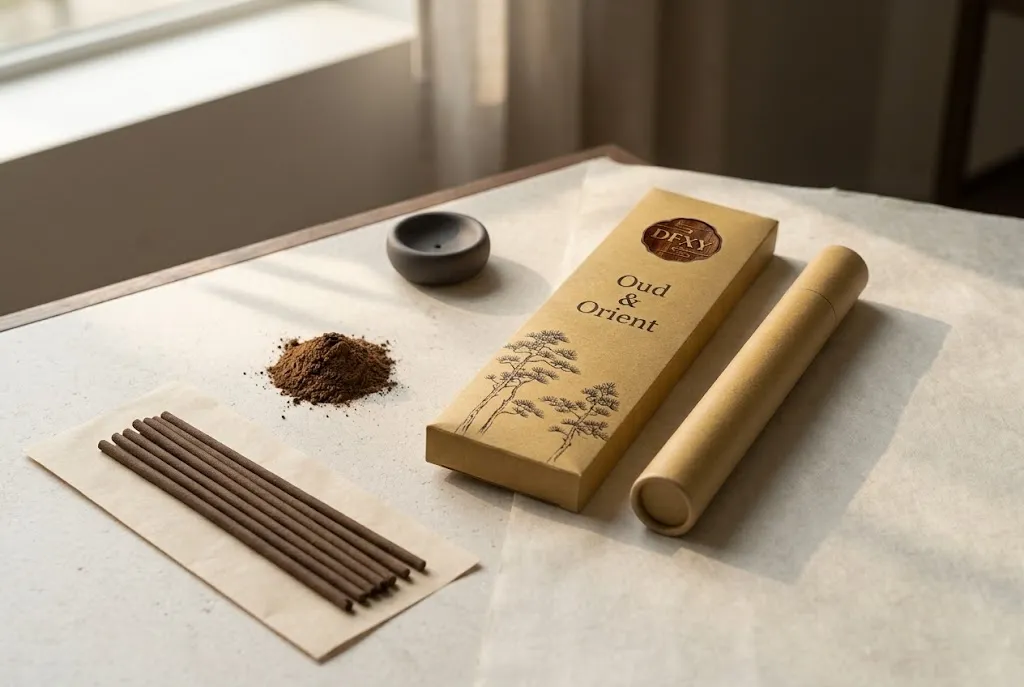
You cannot verify a finished agarwood incense stick from colour, scent, smoke or ash alone. Start with the seller’s exact claim, then check item-specific material information and supporting records. Keep preference, authenticity and safe use separate: a pleasant smell is not proof, and discomfort is a reason to stop rather than keep testing.
Define What the Seller Is Claiming
Start with the exact statement you want to check. A listing that says agarwood powder is one ingredient makes a different claim from one naming an origin, an agarwood percentage or a particular grade. A fragrance described as oud-inspired is different again. Write down the actual wording before deciding what evidence would answer your question.
For a finished stick, the useful question is not simply whether it is real or fake. Ask whether the specific material, composition and origin statements are supported. This guide concerns buying and documenting finished incense, not authenticating raw wood, beads or oil. It does not provide a home test that can establish species, resin content, legal provenance or the complete formula from appearance and smell.
Keep Construction Separate from Composition
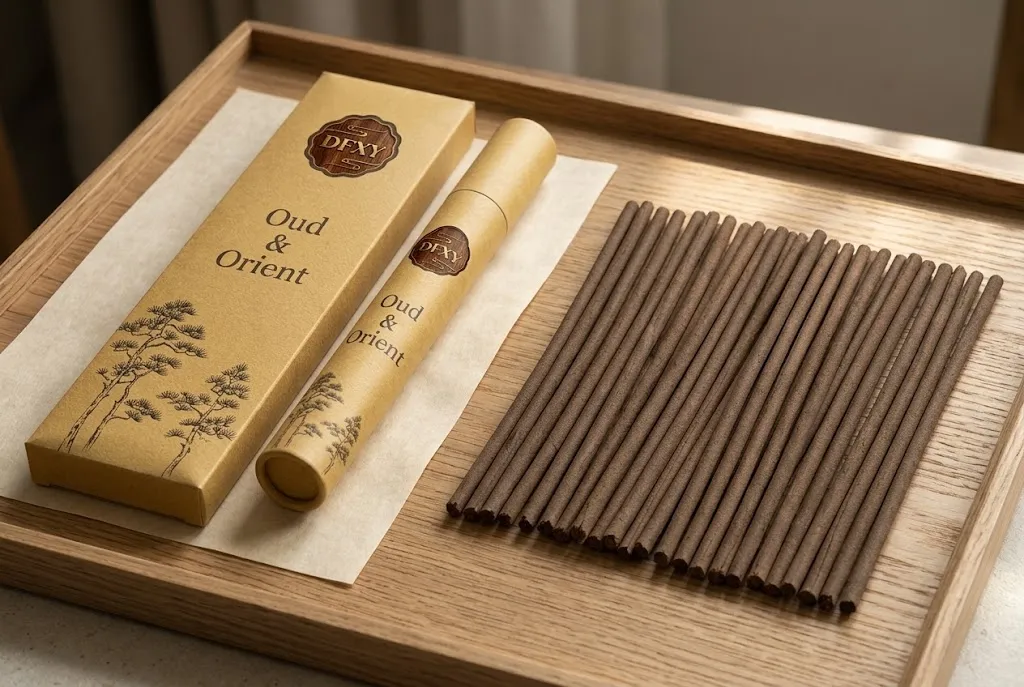
Identify the product format before comparing claims. A bamboo-cored stick has a separate support through its centre; a coreless stick does not have that bamboo support. Neither construction description gives the whole ingredient list. A photograph may help show the format, but it does not establish what every part of a finished stick contains.
Natural agarwood incense is a description that needs product-specific explanation, not a promise that every stick has the same recipe. Ask what the supplier means by natural and whether agarwood is identified as an ingredient rather than only a fragrance direction. The agarwood label-reading guide covers terminology in more detail. Here, concentrate on whether the available information actually supports the claim being made.
Treat Photographs as Identification, Not Proof
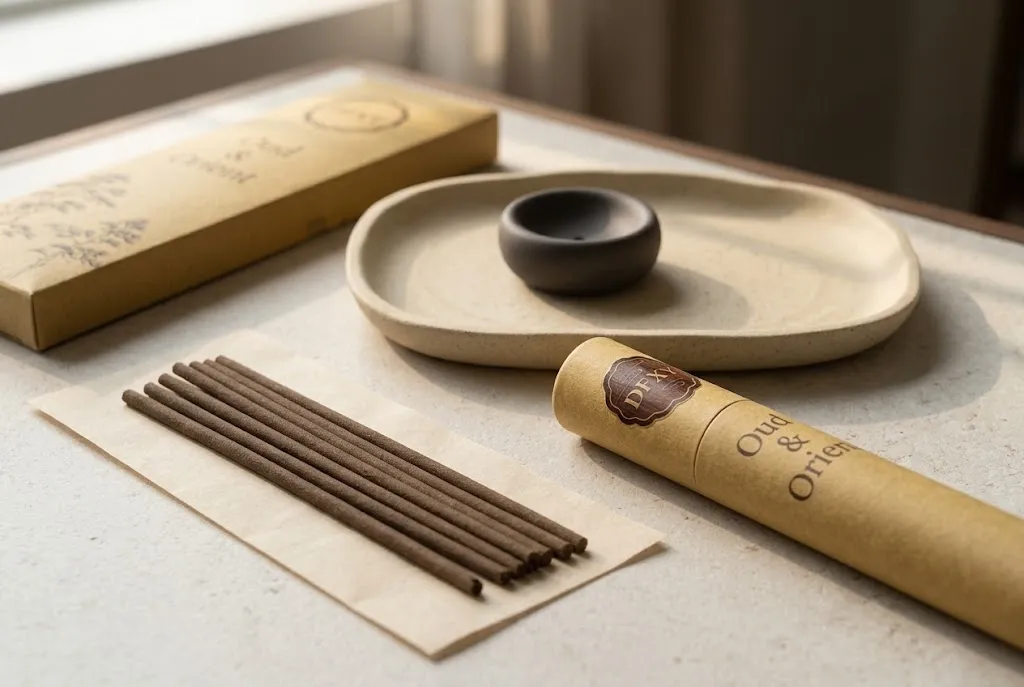
Use photographs to identify the packaging, stick format and item reference. A clear image of what you will receive is more useful than a dramatic close-up with an authenticity badge. Check whether the photograph represents the current product or is an illustration, and whether the listing explains any variation you should expect.
Do not classify a finished incense stick as genuine or counterfeit because it is dark, pale, glossy, uniform or irregular. A processed stick is not an intact piece of wood, so visible grain or apparent resin streaks are not a sufficient ingredient assessment. Likewise, breaking or bending it does not verify its formula. Record an unexpected appearance and ask about it without turning that observation into a definite accusation.
| Claim | Ask about | Not sufficient by itself |
|---|---|---|
| Agarwood is an ingredient | Product-specific composition information | An oud fragrance name |
| A named origin | How the origin statement relates to this item | A photograph of a forest |
| Coreless construction | Whether the stick has an internal bamboo support | A promise of purity |
| A tested product | Sample identity, method, date and result | An unrelated report or certification image |
Do Not Turn Aroma, Smoke or Ash into a Test
A dry scent can help you decide whether you enjoy a fragrance, but it cannot document species, origin or the amount of agarwood in a mixture. A complex aroma does not prove a particular grade, and a simple one does not establish substitution. Describe your impression as an impression rather than a chemical analysis.
Do not burn a stick specifically to test authenticity or compare how much irritation it causes. Pale ash, light smoke and a comfortable session are not certificates of composition or safety. The US EPA identifies combustion as a source of particulate matter. If using incense causes discomfort, stop and avoid further exposure; that action does not require first proving that a product is fake.
Match Supporting Information to the Item
Ask whether the material description applies to the exact product reference and current version. Keep the listing, packaging photographs and written reply together. A supplier story about agarwood in general may be interesting, but it does not automatically describe the box you are purchasing. The same limitation applies to a photograph of raw wood beside finished sticks.
If an origin, production method or ingredient claim matters to your decision, request information specifically related to it. Do not assume that every purchase requires a full trade dossier or that missing public supplier names prove deception. The practical aim is a clear, consistent explanation of the claim. Where an essential detail remains unconfirmed, record it as unconfirmed and decide whether that uncertainty is acceptable before paying.
Read Test Reports within Their Actual Scope
If a seller supplies a test report, check what was tested, by whom, when and for which sample. A report for raw material is not automatically a report for the finished incense. A result addressing one substance does not establish every ingredient, every batch or a general safe-to-burn claim. Ask how the report relates to the product offered.
Research can explain why technical assessment is more specific than a visual checklist. For example, a published study of agarwood incense smoke used gas chromatography-mass spectrometry to examine chemical profiles. That study is not a consumer certification standard and does not validate a particular retail product. For a high-value dispute, ask an appropriately qualified independent specialist what the available sample and method could establish before commissioning work.
Evaluate the Answer, Not Just the Confidence
A useful reply addresses your exact question. If you asked whether fragrance was added, an answer about traditional craftsmanship does not resolve it. If you asked which product a report covers, a repeated premium label is not a link between the report and your box. Separate a clear answer, a qualified answer and a question that remains unanswered.
For DFXY enquiries, send the product reference and the wording you want clarified. Ask the team to confirm only information it can substantiate for that item. Do not assume that every DFXY listing has the same composition, a laboratory report, a sample option or a particular sourcing document. Clear limits are more useful than a broad brand-wide assurance that cannot be checked.
Choose a Proportionate Next Step
Before ordering, decide which unanswered points are essential. You may be comfortable buying a clearly described blended fragrance, but not if you were specifically seeking an ingredient-led product and cannot establish the distinction. That is a purchasing boundary, not a universal judgment that one composition or production method is inferior.
If you already received a product that differs from its listing, retain the packaging and order records, document the discrepancy and ask about the applicable resolution process. Do not damage or burn further samples just to create evidence. Avoid public authenticity claims that go beyond what you can support. A responsible decision may be to seek clarification, pause the purchase or choose a more transparent listing rather than continue guessing from sensory signs.
Keep three separate notes: the claim as written, the information supplied in support, and anything still unclear. Do not fill a gap with an assumption from another product or an earlier order. If the listing changes, retain a dated copy of the version used for your purchase so both parties can discuss the same information.
Frequently Asked Questions
Can colour prove that agarwood incense is real?
No. Colour alone does not establish a finished stick’s ingredients, origin or grade. Use it to identify an item or document a discrepancy, not to issue an authenticity verdict.
Does coreless mean pure agarwood?
No. Coreless describes the absence of an internal bamboo support. It does not provide the full composition or establish an agarwood percentage.
Does a strong fragrance mean added perfume?
Not necessarily. Scent strength is an observation, not an ingredient analysis. Ask about any added-fragrance statement for the specific product.
Can pale ash or gentle smoke prove authenticity?
No. Ash and smoke observations cannot independently verify the formula. Do not conduct burning tests to decide whether a product is safe or genuine.
What should I check in a test report?
Check the sample identity, date, issuing organisation, method and actual result. Ask how it relates to the product and batch offered, and do not extend the conclusion beyond the test scope.
What if the seller cannot confirm an important detail?
Treat the detail as unconfirmed. Ask a focused follow-up or postpone purchase. Lack of information is a reason to reconsider your decision, not automatic proof of counterfeiting.