
Tell us what you are looking for—daily incense, gifting, guest hospitality, or retail sourcing—and we will help you choose a suitable format.
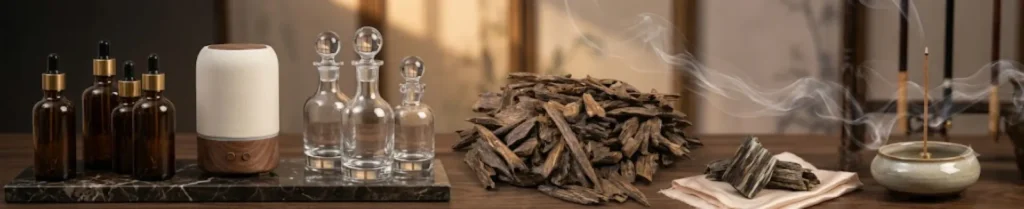
For experienced agarwood enthusiasts, the difference between ordinary incense and exceptional incense often comes down to one thing: the quality and story of the raw material.
Among the many terms used in the agarwood market, Ban Tou Agarwood is frequently mentioned by collectors, incense makers, and premium incense brands. However, unlike botanical species names such as Aquilaria sinensis or Aquilaria crassna, Ban Tou is not a species classification. It describes a specific type of agarwood material associated with the lower section of an agarwood tree and the way resin develops in that area.
Ban Tou Agarwood refers to agarwood material obtained from the lower trunk, stump, or base sections of an Aquilaria tree.
The term “Ban Tou” is commonly used in Chinese incense culture to describe these base sections, where resin formation can occur after natural damage, cutting, or stress to the tree.
Agarwood itself is not naturally fragrant wood. It is created through a long biological process.
When an Aquilaria tree experiences injury or stress, it produces resin as part of its defense response. Over many years, this resin gradually accumulates inside the wood, transforming ordinary wood tissue into fragrant agarwood.
The value of Ban Tou material comes from its formation environment.
The lower parts of the tree often experience:
Because of this, resin-rich Ban Tou material is highly valued among incense makers who seek a deeper and more complex aromatic profile.
The value of Ban Tou Agarwood is not simply because of its name.
Its importance comes from several material characteristics.
The fragrance of agarwood comes primarily from its resin content.
A resin-rich piece of agarwood generally provides:
For premium agarwood incense, the raw material quality determines the foundation of the final aroma.
A beautifully crafted incense stick cannot create depth that does not already exist in the agarwood itself.
One of the biggest differences between authentic agarwood incense and artificially scented incense is how the fragrance evolves.
Synthetic oud fragrances are designed to create an immediate and consistent impression.
Natural agarwood behaves differently.
The aroma gradually changes during burning:
This gradual transformation is one of the reasons experienced incense users appreciate natural agarwood.
The fragrance is not simply released — it unfolds.
There is no single scent profile that defines every Ban Tou Agarwood product.
The final aroma depends on:
However, carefully selected Ban Tou Agarwood used for incense often presents characteristics such as:
A gentle oily sweetness that comes from natural agarwood resin.
A mature woody tone that feels deeper and smoother than ordinary wood-based incense.
Some high-quality materials may develop honey-like, floral, or slightly creamy notes.
Instead of a sharp fragrance impact, natural agarwood tends to leave a quiet and refined impression.
For users familiar with oud, this difference is important:
Premium natural agarwood is not about maximum projection.
It is about complexity, balance, and evolution.
The difference is mainly related to material origin and resin formation.
Regular agarwood may come from various parts of the tree, including branches, trunk sections, or cultivated agarwood material.
Ban Tou Agarwood specifically refers to lower tree sections where resin development may occur under unique conditions.
This does not automatically mean every Ban Tou piece is superior.
Quality still depends on:
A knowledgeable buyer should look beyond names and evaluate the actual material.
For incense lovers, raw material is only part of the equation.
The construction of the incense stick also matters.
Many commercial incense products use:
These methods can create a strong initial smell but may hide the natural character of agarwood.
A premium agarwood incense stick should clearly communicate:
For customers searching for natural agarwood without fragrance oil, transparency is one of the strongest signs of quality.
A well-made Ban Tou Agarwood incense allows the original material to remain the main source of fragrance.
Before purchasing, experienced buyers usually consider several questions.
A trustworthy seller should provide information about:
Avoid descriptions that only use vague words such as:
without explaining actual fragrance characteristics.
Better descriptions explain:
A premium product should clearly state whether it contains:
Transparency builds trust.
No. Ban Tou is not a botanical species. It describes a type of agarwood material associated with the lower section or base area of an Aquilaria tree. The actual species should be identified separately.
No. Aroma depends on species, resin content, formation conditions, and processing. Some Ban Tou materials are sweeter, while others may express deeper woody or earthy notes.
Not necessarily. Ban Tou is valued because of its potential resin characteristics, but quality depends on the actual material rather than the name alone.
Ban Tou Agarwood is popular because resin-rich material can provide a more layered, evolving fragrance experience that suits meditation, tea ceremony, and traditional incense appreciation.
Look for:
A reliable seller explains the material instead of relying only on luxury descriptions.
Ban Tou Agarwood represents more than a marketing term.
Its value comes from the relationship between tree, resin, time, and craftsmanship.
For those who appreciate premium agarwood incense sticks, the goal is not simply finding the strongest fragrance.
The true experience comes from discovering a natural aroma that develops slowly, reveals different layers, and reflects the character of the original material.
A high-quality Ban Tou Agarwood incense is not created by adding more fragrance.
It is created by preserving what nature has already developed.

As a refined voice in the world of agarwood and incense, DFXY shares thoughtful articles on handmade incense, scent appreciation, craftsmanship, and the quiet rituals of modern living. These writings are designed to help readers discover the depth of natural agarwood, understand the value of artisanal incense making, and find a more grounded, elegant way to experience fragrance in daily life.
Feel free to contact us, We’ll get backyou soon as we can.